Featured Painting: ‘Cool Shades’
Posted by Chris Niblock in art on January 16, 2012
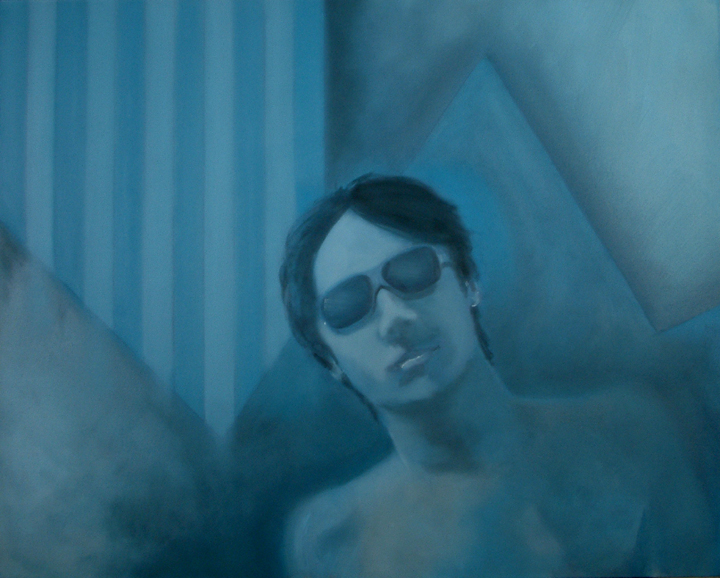
My original intention when I started this painting was to produce an abstract piece. After working on it for a while however, I decided that the idea wasn’t going anywhere. The vertical blue and whites stripes were suggestive of the ultra violet emitting flourescent tubes used in sunbeds, so I added the figure of a guy wearing sunglasses. I had employed a colour palette from the cooler end of the spectrum and this provided me with a title for the work.
Cool Shades is currently on show along with Cosmic Collision (previously featured on this blog) until 3rd February at the Ludlow Assembly Rooms gallery, Mill Street, Ludlow SY8 1AZ. Both Paintings are for sale. Cool Shades is priced at £250 and Cosmic Collision at £350. The artworks are painted in oils on good quality, deep profile canvas 60 x 76 cms in size.
Original artworks copyright Chris Niblock
They seek him here, they seek him there . . .
Posted by Chris Niblock in science/humour on December 14, 2011
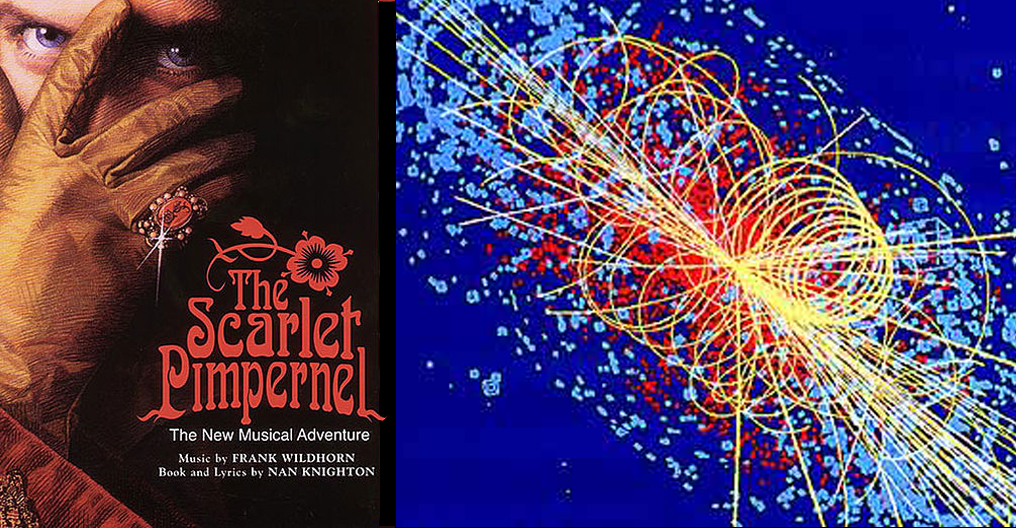
A few months ago they said they might have missed it. Now they’re claiming they may have glimpsed it. The Higgs Boson particle is proving as elusive as the Scarlet Pimpernel.
The Scarlet Pimpernel is of course a fictional character: a foppish English aristo who risks his life to save French aristos from the guillotine during the reign of terror, but he does share a number of important characteristics with the Higgs Boson particle.
1) He constantly eludes detection
2) No one is quite sure if he exists or if he is just a myth.
Imagine the Higgs boson was a person rather than a particle. Say a clever and resourceful jewel thief, wanted all over Europe but no one knows for certain who he is or what he looks like. A French professor claiming to have seen him reports his sighting to the local gendarmerie.
‘So professor, you say you saw Higgs Boson.’
‘Yes. Yes, I did,’ the professor replies. The man is red faced and excited and the detective wonders if he has been drinking.
‘And where was this professor?’
‘It was in the tunnel at Cern.’
The detective leans forward eagerly. He can see the headlines now: Inspector Clouseau – the man who brought Higgs Boson in. ‘I need to know when, and more importantly I need a description – what did this man look like?’
The professor looks stricken. He hesitates. ‘Well, it was . . . erm, very dark in there. ‘
‘But, you saw him, right?’
‘It was more in the nature of a glimpse actually . . . ‘
‘A glimpse! The detective shouts, then in a calmer voice, ‘Just how long was he visible for?’
‘Well, it ‘s hard to be absolutely precise about that.’ The professor pulls a sheaf of computer printouts from the briefcase he’s been clutching, ‘If you take a look at these numbers, you can see there’s a spike in the data just here . . .’
The detective sighs. ‘Thank you professor. I don’t think we need detain you any longer.’
Featured Painting: Scaramouche Jones
Posted by Chris Niblock in art/drama on November 22, 2011

I was inspired to paint this after seeing Pete Postlethwaite perform the role of the eponymous clown in this one man show at Ludlow Assembly Rooms. It’s based on a publicity still for the show, but I decided to heighten the drama of the picture by adding a stronger background. Coincidently, a year or so later I found a buyer for the painting at the very same assembly rooms.
Scaramouche, a roguish clown character of the Italian Commedia dell’arte, also features in the popular song Bohemian Rhapsody by Queen. The name was originally that of a stock character who featured in 17th century Italian farce, in which another regular character named Harlequin would beat him for his bragging and for his cowardice.
Original artwork: oils on canvas copyright Chris Niblock
Putin’s Cover Girl
Posted by Chris Niblock in life/humour on October 24, 2011

In the year since she was deported from America in the biggest spy swap since the end of the Cold War, Anna Vasil’yevna Kushchyenko: aka Anna Chapman, has gone from undercover spy to pin-up cover girl. On her return to Russia, she was toasted by Putin at a private gathering and invited to join a pro-Putin youth group; her job to provide leadership advice to Russian youth. So far, so good, but then she posed half-naked for a men’s magazine holding a gun. Somewhat surprisingly, this embarrassed the former KGB agent Mr. Putin who has not only posed topless with a gun, but with horses and a fishing rod.
Then in an incident more reminiscent of a Carry On film than John Le Carre, the Bondski girl took to the catwalk during a fashion show brandishing a pistol, which, much to the delight of her detractors, she proceeded to drop in front of the attendant press corps. Now ‘the spy who came in from the cold’ could find herself back out in it. Given the scanty clothing she’s been wearing lately and with the harsh Moscow winter just around the corner, things could prove very cold indeed for the failed spy.
I don’t know if British Intelligence has someone like Anna working undercover in Moscow but I’m betting her choice of underwear will be far more sensible than Chapman’s: a nice warm thermal vest from M & S and some thick woolly tights. Let’s hope that like the Americans, would be Russian traitors will just love her English accent!
Featured Painting: ‘Cosmic Collision’
Posted by Chris Niblock in spaceflight/art on September 26, 2011
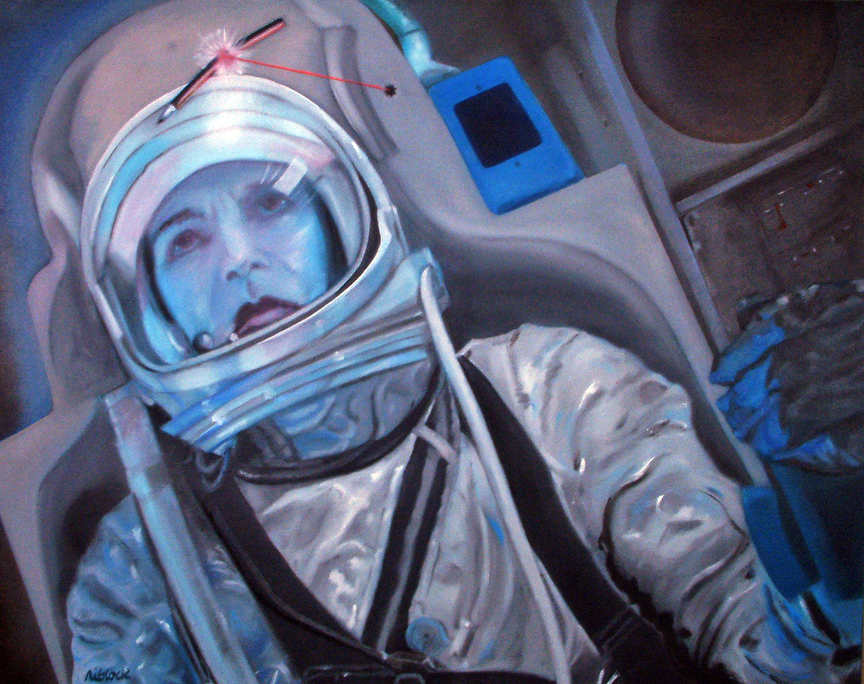
This painting was inspired by a still from the movie The Right Stuff. Based on the book of the same name by Tom Wolfe, it tells the story of test pilot Chuck Yeager‘s attempts to break the sound barrier in a rocket powered plane and of the seven astronauts of NASA’s Project Mercury. The Cold War was at it’s height and America and Russia were locked in the Space Race, the original impetus for which was the desire to build bigger and more powerful intercontinental missiles to carry the atomic warheads they were both stockpiling.
Project Mercury was something of a stop-gap. The Americans had talked of building a small winged vehicle along the lines of what would eventually become the much larger space shuttle, however the launch of Sputnik 1 by the Russians in October 1957 convinced the Americans that the soviets were way ahead of them in terms of lifting power. If they were to put a man into space before the Russians they would have to rely on their existing rocketry. The Mercury spacecraft was basically ‘a man in a can’ which would be shot into space atop a Redstone missile. The original design called for the craft to be ‘flown by wire’ from the team on the ground, but the Mercury astronauts – all test pilots – baulked at this and the capsule was fitted with a manual override.
In the event, the Russians beat them to it when on the 12th April 1961, Yuri Gagarin became the first man to orbit the earth. Ten months later John Glen would become the first American to do the same in the Mercury capsule ‘Freedom 7’.
Original oil painting on canvas copyright Chris Niblock
Why men should be afraid of these mice . . .
Posted by Chris Niblock in science/humour on August 15, 2011

‘Are you a man or a mouse?’ was given new meaning this week, with the announcement that scientists have created sperm in the laboratory and succeeded in using it to produce healthy offspring. True the ‘babies’ in this instance were mice not men, but the ultimate aim of the experiment is to aid fertility in humans.
Researchers at Kyoto University took embryonic stem cells from the mice and by adding growth factors, created ‘primordial germ cells’. These cells were then inserted into the testes of infertile mice – I wonder where they got them from – infertile mice must be as rare as rocking horse shit, given the rodents’ prodigious ability to reproduce themselves!
The techniques used in this research would have to be modified somewhat if they are to be used in humans, as men don’t have embryonic stem cells which could be used to generate sperm in the same way. However, scientists are said to be working on a method which involves reprogramming adult cells so that they become embryonic cells.
This experiment and others like it, could eventually lead to a man’s role in the reproductive process becoming redundant. The sperm count has been dropping for years anyway, and along with it, the male’s traditional role in society. Some scientists believe that it will eventually be possible to create sperm from female stem cells, thus eliminating the need for men altogether.
I explore this last scenario in my debut novel Back Dated. Following a visit from a strange young woman, Sci-fi writer Ray Flaxman is pitched headlong into a dystopian future, where women rule the new Britannia and men are facing extinction. Feminists often claim that the world would be a better place if women were running things but I wonder . . .
In 1971, the then Education Secretary and mother, Margaret Thatcher abolished school milk, leaving many children without their daily pinta. Later, as Prime Minister she became known as the Iron Lady. It was often said of her that she was more of a man than any of the men in her cabinet. Under her premiership we saw the rise of the politics of greed and the me,me,me society which is with us still today.
The man who invented the Time Machine
Posted by Chris Niblock in science fiction on August 1, 2011

Herbert George Wells (1866-1946), along with Jules Verne (1828-1905) is generally regarded as the father of science fiction, though it could be argued that the young Mary Shelley beat them both to it with the publication in 1818 of her novel Frankenstein.
The novel came to be written as the result of a competition between herself, her lover, the poet Percy Bysshe Shelley and Lord Byron, to see who could write the best horror story. Frankenstein nevertheless has at its core some of the basic elements of science fiction: the fanatical scientist who pushes science too far and in doing so, creates a monster he cannot control.
But it was H.G. Wells more than anyone else, who in four of his best known novels established the basic ingredients of the science fiction genre, though he preferred to call them scientific romances.*
Time travel and the dystopian future: The Time Machine (1895).
The egotistical scientist who overreaches himself: The Invisible Man (1897).
Alien Invasions: The War of the Worlds (1898).
Space Travel: The First Men in the Moon (1901).
H.G. Wells wasn’t the first writer to feature time travel in a story but he was the first to use the term Time Machine. In a career spanning sixty years, he was a prolific and sometimes prophetic writer of both fiction and non fiction, novels, short stories and articles. But it is for these four novels that he will be most remembered.
All four have been adapted for the cinema but it was another Wells – American actor and director Orson Welles, and his radio adaptation of The War of the Worlds which had the greatest impact on an audience. On the 30th October 1938, Halloween night, Welles directed and performed an updated version of the work as a series of simulated news bulletins, which had a section of the audience convinced that America was being invaded by Martians. Following the broadcast, Welles was castigated for cruelly deceiving his listeners but it made him famous.
*The term science fiction was coined in 1851 but didn’t really catch on until the 1930’s when it was popularised by the American editor Hugo Gernsback, the founder of the first science fiction magazine Amazing Stories in 1926. The Annual Science Fiction Achievement Awards, the ‘Hugo’s’ are named after him.
If you enjoy reading about Time Travel check out my novel Back Dated. Just click on the links to the right of this page and they will take you to my amazon home page, where you can read the first three chapters for FREE!
Start screaming Kate – Hammer Horror is back!
Posted by Chris Niblock in Movies on July 25, 2011

I was amused to read that Hammer Films is back in business with the news that Harry Potter actor Daniel Radcliffe is to star in ‘The Woman in Black‘ for them. Rather like most of the characters featured in their movies, I’d assumed that the company was long since dead. But it seems they simply became the undead and were just biding their time until a fresh crop of victims came along. In their heyday (1955 to 1959) the films were considered quite scary, but compared to later shockers like’ The Texas Chainsaw Massacre’ and’ Nightmare on Elm Street’, there was more ‘ham’ than horror in classics like ‘Dracula’ and ‘The Curse of Frankenstein’. These films made stars of Peter Cushing and Christopher Lee and much later Ingrid Pitt, most fondly remembered for her role in ‘Virgin Vampires’ alongside Kate O’Mara.
As a teenager, singer/songwriter Kate Bush dubbed the screams for Hammer, and featured a song entitled ‘Hammer Horror’ on her second album ‘Lionheart’.
But what I found even more interesting is the news that Hammer have gone into the publishing business with a series of gothic horror novels. Award winning author of ‘Oranges Are Not The Only Fruit’, Jeanette Winterson is to pen a novella for them. Imagine the creative possibilities this opens up for the audio book versions of these horror stories. Let’s hope they can persuade Kate Bush to provide the screams . . . we haven’t heard much from her lately and as a big fan, I’d welcome any new sounds from her even if it is just a blood curdling scream of terror.
In Memoriam: Amy Winehouse
Posted by Chris Niblock in art/music on July 24, 2011

AMY WINEHOUSE
1983 – 2011
Original Painting: Oils on canvas copyright Chris Niblock 2009
Serena and Back Dated get a makeover.
Posted by Chris Niblock in writing fiction/humour on July 18, 2011
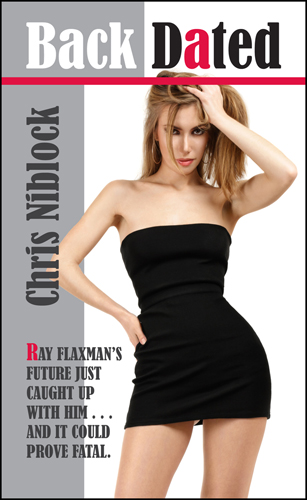
It would have been neat to get it right first time, but having lived with it for three months, I’ve decided that my orignal cover design for Back Dated was a little too subtle. So, I’ve re-designed it and now feel it accurately reflects the novel’s content and storyline. I think you’ll agree Serena’s looking a lot better for it. Hope you like it. In fact, I’m hoping you’ll like it enough to buy it.
I’ve made it easy for you: just click on the links below the smaller pic of the book’s cover on the right and it will take you straight to Back Dated’s page on Amazon. For just £0.86 ($1.34 if you’re buying from Amazon.com), it’s yours.
Don’t have a Kindle? No problem, Amazon thoughtfully provide FREE App’s which enable you to download my eBook onto an iPad, iPhone and similar devices, or onto your laptop or PC. You can even download the first couple of chapters for Free before buying! So, what have you got to lose?
Still worried you might not like it. Well if you enjoyed TV series like ‘Life on Mars‘ and ‘Ashes to Ashes‘, or books and movies like ‘Logan’s Run‘ and ‘The Time Travelers Wife’, I think you’ll enjoy Back Dated.
Chris Niblock
A Stirring in the Blood

Buy it from amazon.co.uk


 A Kyndle in the Mynd